
Elevating Silicon Valley Homes: Master-Grade Interior Painting Services in San Jose CA
Professional interior painting services in San Jose CA require high-durability coatings tailored to diverse microclimates and varied residential architectural styles. We deliver comprehensive surface preparation, structural drywall repair, and precision application engineered to withstand regional thermal shifts, protect substrates, and elevate property values across Silicon Valley residences.
Our experience operating throughout Santa Clara County reveals that interior painting is not merely a cosmetic update, but an essential component of comprehensive home maintenance and architectural preservation. San Jose properties vary from mid-century Eichler homes with expansive post-and-beam woodwork to sprawling modern estates in Silver Creek and historic Victorians in the Rose Garden neighborhood. Each architectural style presents distinct substrate dynamics, light reflection challenges, and material compatibility requirements.
We approach every residential project with a structural engineering perspective, assessing wall porosity, drywall joint integrity, and existing paint film stability before applying a single drop of primer. When contracting residential interior work in California, property owners must ensure their service provider maintains proper licensing through the California Contractors State License Board under the C-33 Painting and Decorating classification. Operating as fully licensed professionals allows us to back our interior work with comprehensive liability coverage, strict safety protocols, and long-term durability guarantees.
Regional Environmental Standards and Volatile Organic Compound Compliance
Interior painting in the San Jose region must comply strictly with regional environmental mandates while preserving long-term finish longevity. We utilize advanced zero-VOC formulations and low-emission coatings that meet local air district standards without compromising color depth, scrub resistance, or indoor atmospheric purity during multi-room interior renovations.
Under regulations enforced by the Bay Area Air Quality Management District (BAAQMD) Rule 8-3, architectural coatings applied in Santa Clara County are subject to stringent volatile organic compound limits. Flat coatings must not exceed 50 grams of VOC per liter, while non-flat finishes and specialized primers are held to similarly strict environmental benchmarks. We work exclusively with modern, high-solid waterborne resins that utilize zero-VOC colorant systems, preventing harmful chemical off-gassing inside closed residential environments.
Maintaining clean indoor air quality is especially critical for Silicon Valley homeowners who utilize tight envelope HVAC systems and smart home filtration networks. Older paint formulations relied on toxic solvents to achieve leveling and sheen uniformity, but our modern cross-linking acrylic paints achieve superior surface hardness through advanced resin technology. This clean application methodology protects your household from respiratory irritants while satisfying every municipal environmental code in Northern California.
Scientific Performance Trade-Offs Across Paint Formulations and Sheens
Selecting interior paint sheens and resin formulations requires balancing aesthetic preferences against mechanical wear resistance and maintenance demands. We evaluate volume solids, pigment-binder ratios, and cleanability across flat, eggshell, satin, and semi-gloss finishes to establish custom coating specifications for every room in your residence.
The physical longevity of an interior paint film directly correlates with its volume solids content, which represents the dry material remaining after solvents evaporate. Premium paint formulations contain between 40 percent and 48 percent volume solids, producing a thicker dry film that resists abrasion, scuffing, and moisture intrusion better than budget coatings containing under 35 percent volume solids. Furthermore, scrub resistance is measured under standardized ASTM D2486 protocols, where top-tier interior coatings endure over 1,400 scrub cycles before film degradation occurs.
To assist San Jose homeowners in making informed interior finish decisions, we have structured the technical trade-offs between common sheen levels, resin properties, and practical applications in the table below.
| Paint Sheen & Grade | Volume Solids (%) | ASTM D2486 Scrub Resistance | Recommended Interior Application | Primary Practical Advantage | Key Maintenance Trade-Off |
|---|---|---|---|---|---|
| Premium Matte / Flat | 41% – 44% | 1,000 – 1,200 Cycles | Formal Living Rooms, Master Ceilings | Hides structural drywall imperfections completely | Requires gentle spot cleaning to avoid burnishing |
| Ceramic Eggshell | 42% – 46% | 1,400 – 1,600 Cycles | Bedrooms, Family Rooms, Dining Areas | Balances low reflectivity with washability | Requires consistent roller technique to prevent lap lines |
| Urethane Acrylic Satin | 44% – 48% | 1,800 – 2,000+ Cycles | Hallways, Children Rooms, Kitchen Walls | Resists moisture, oils, and frequent scrubbing | Highlights underlying drywall texture defects |
| Waterborne Semi-Gloss | 45% – 48% | 2,200+ Cycles | Baseboards, Trim, Doors, Bathrooms | Superior impact resistance and liquid shedding | Requires thorough sanding for mechanical adhesion |
Field Case Studies: Resolving Complex Silicon Valley Interior Substrate Failures
Resolving complex substrate failures demands technical diagnostic testing and field-tested surface remediation strategies before applying topcoats. We routinely diagnose and resolve historic trim delamination, structural drywall cracking, and moisture-induced blistering across San Jose neighborhoods through engineered primer barriers and specialized elastomeric repair compounds.
During a comprehensive restoration of a 1970s ranch home in Willow Glen, we encountered widespread micro-cracking along ceiling drywall joints caused by regional thermal movement and foundation settling. Standard spackling compounds previously applied by amateur painters had repeatedly failed under structural expansion stresses. We resolved the failure by v-grooving the crack lines, applying high-tensile mesh reinforcement, embedding a flexible vinyl-base compound, and sealing the repairs with a 100 percent acrylic elastomeric primer before topcoating.
In another complex project located in the historic Rose Garden district, we addressed severe paint peeling on mahogany window casings and trim originally coated in 1940s oil-based enamel. Applying modern latex paints directly over legacy alkyd coatings without bonding agents causes complete film adhesion failure within months. Our team mechanically abraded the trim back to sound timber, treated tannin bleeds with a high-solids shellac primer, and applied two coats of self-leveling urethane-modified acrylic enamel, establishing a rock-hard finish guaranteed not to delaminate.
Step-by-Step Professional Interior Painting Execution Protocol
Achieving an impeccable interior paint finish requires following a standardized six-stage professional execution sequence. We guide every San Jose project through meticulous room containment, surface remediation, substrate priming, micro-sanding between coats, precision coat application, and digital light quality audits to guarantee flawless finish uniformity.
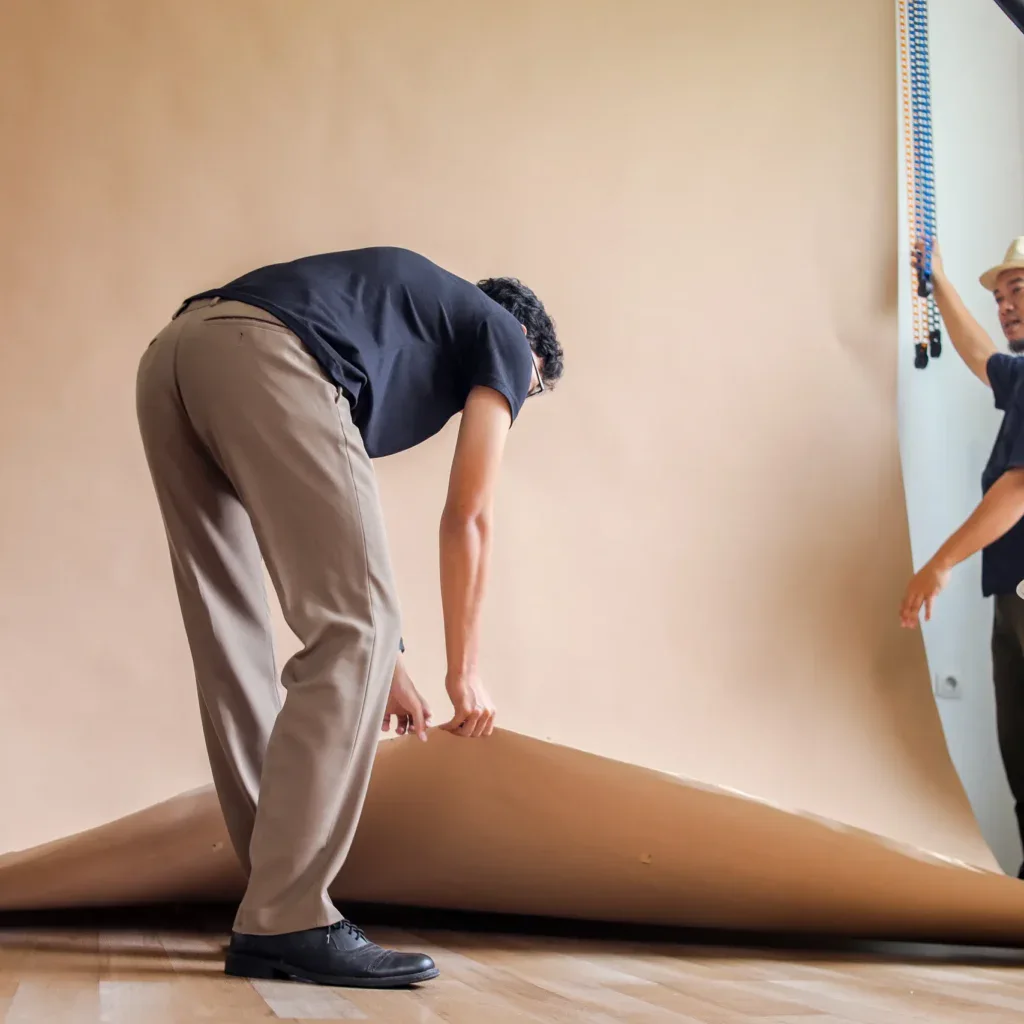
- Environmental Containment and Furniture Protection: We mask all floor surfaces using heavy craft paper and leak-proof drop cloths, while sealing furniture, light fixtures, and doorways under dust-blocking plastic sheeting.
- Substrate Remediation and Prep: Our team fills nail holes, repairs drywall fractures, coats surface blemishes with specialized patch compounds, and sands all walls to achieve an even absorption profile.
- Stain Blocking and Specialty Priming: We apply targeted primer coats over water stains, smoke damage, tannin bleeds, or bare drywall patches to ensure uniform topcoat adhesion and color consistency.
- Micro-Sanding and Surface De-Glossing: We mechanically sand glossy trim and previously painted surfaces with fine-grit abrasives to create microscopic mechanical profile grooves for maximum paint bonding.
- Precision Topcoat Application: We apply two complete coats of premium, zero-VOC acrylic paint using high-efficiency airless sprayers, micro-fiber rollers, and hand-brushed perimeter edging.
- Multi-Angle Quality Audit and Clean-Up: We inspect all painted surfaces using 5000-K lumen directional work lights to verify coverage before removing protection materials and vacuuming with HEPA filters.
Decision Framework: Selecting the Optimal System for Your Space
Choosing the correct interior coating strategy depends on room function, ambient moisture levels, wall texture, and anticipated surface contact. We apply conditional evaluation matrixes to determine whether high-performance urethane acrylics, self-priming latex solids, or moisture-resistant bath enamels provide the highest return on investment for your space.
If your project involves high-humidity areas such as master bathrooms, spa suites, or poorly ventilated laundry rooms, prioritize 100 percent acrylic formulas enriched with EPA-registered antimicrobial agents, as detailed by the United States Environmental Protection Agency for indoor moisture control. These coatings form a non-porous moisture barrier that actively inhibits mold growth and prevents steam-induced film blistering. Conversely, if you are painting formal dining rooms or living areas with smooth level-five drywall, select premium ceramic-infused matte coatings to achieve deep color saturation without light glare.
If your home features dark hardwood trim, solid core doors, or custom kitchen cabinetry, transition away from traditional solvent enamels toward modern waterborne alkyd formulations. These hybrid resins deliver the self-leveling smoothness and hardness of oil-based paints without yellowing over time or emitting high VOC levels. If your focus is high-traffic hallway maintenance, choose a satin finish with high volume solids to allow repeated scrubbing without gloss alteration.
Frequently Asked Questions
What is the average timeframe for completing a full interior painting project in a San Jose home?
A standard full interior painting project for a 2,000-square-foot San Jose home typically takes three to five business days to complete fully. Our timeline accounts for meticulous surface preparation, drywall repair curing, multi-stage priming, double topcoat application, and final illumination quality audits. This structured sequence minimizes household disruption while ensuring maximum coating performance.
How do Bay Area low-VOC paint regulations impact durability and color retention?
Modern low-VOC paints compliant with local air district rules deliver superior durability and color retention compared to legacy solvent coatings. Advanced cross-linking acrylic polymers allow zero-VOC paints to cure faster, resist yellowing, and form a denser protective barrier. We utilize low-emission coatings that elevate washability while maintaining clean indoor ambient air quality.
Why is specialized priming necessary when transitioning from oil-based to water-based interior paints?
Specialized bonding primers are essential when transitioning from legacy oil-based enamels to modern water-based acrylic interior paints. Waterborne topcoats cannot adhere directly to slick alkyd surfaces without peeling away under mechanical stress. We perform cross-hatch adhesion testing and apply shellac or acrylic bonding primers to create an unbreakable chemical bond.
How do we protect electronics and high-value tech infrastructure during interior painting in Silicon Valley homes?
We protect electronic equipment and home automation networks by installing sealed anti-static dust containment barriers and isolation shrouds. Our sanding operations utilize HEPA-filtered dust extraction units that capture 99.97 percent of airborne drywall particles at the tool source. This prevents fine particulates from entering delicate cooling vents, optical sensors, or air handling ductwork.
What paint finish provides the best performance for high-traffic hallways and family spaces?
A ceramic-infused eggshell or urethane-modified satin finish delivers optimal performance for high-traffic hallways and family living areas. These specialized finishes feature elevated volume solids that resist scuff marks, oil penetration, and mechanical abrasion. Their balanced film density allows frequent scrubbing with neutral cleaners without causing surface burnishing or gloss alteration.
Sources
- Bay Area Air Quality Management District (BAAQMD) – Regulation 8, Rule 3: Architectural Coatings Compliance Standards. https://www.baaqmd.gov
- California Contractors State License Board (CSLB) – C-33 Painting and Decorating License Requirements and Safety Codes. https://www.cslb.ca.gov
- United States Environmental Protection Agency (EPA) – Architectural Coatings and Indoor Air Quality Guidelines. https://www.epa.gov