

We engaged D&D Home remodeling to install new countertops, new circuit breakers and lightings, new attic insulation, sewer pipes and other plumbing work, new tile floor and remove weight bearing wall to open up the dining room.
D&D work was very professional – the work spaces were screened off, floors were covered with boards before work started on day one.
The work team Dan, Eli, Terence and team – is delightful to deal. Response to questions are prompt and thorough.
We met Dan on the first meeting and Dan helped us with the work scope and patiently explained the city permit requirement.
D&D then took care of all required city permits on a very timely basis.
Work spaces are cleaned up after each work day and renovation debris were cleared regularly.
D&D cost is reasonable given the professionalism of the work and the high level of customer service.
The results met our expectations for a low stress renovation and a beautiful dining room & kitchen.


We engaged D&D Home remodeling to install new countertops, new circuit breakers and lightings, new attic insulation, sewer pipes and other plumbing work, new tile floor and remove weight bearing wall to open up the dining room.
D&D work was very professional – the work spaces were screened off, floors were covered with boards before work started on day one.
The work team Dan, Eli, Terence and team – is delightful to deal. Response to questions are prompt and thorough.
We met Dan at our first meeting. Dan helped us with the work scope and patiently explained the permit requirements for the structural and electrical parts of the project.
D&D took care of all required city permits on a very timely basis.
Work spaces are cleaned up after each work day and renovation debris were cleared regularly.
The results met our expectations for a low stress renovation and a beautiful dining room & kitchen.


My wife and I hired D&D Home Remodeling for our kitchen remodel, and we’re really happy with how it turned out.
We wanted a kitchen that felt more open and had better storage, and the team helped us figure out a layout that made sense for how we actually use the space.
Mariana, our designer, helped us choose the cabinets, countertops, and finishes without making the whole process feel overwhelming.
There are a lot more decisions involved than we expected! Ilya, our project manager, was easy to talk to and took the time to answer our questions along the way.
The kitchen feels bigger, it’s easier to cook in, and it finally feels like our home.
Glad we went with D&D.

We finished a complete remodeling with D&D home remodeling
We did the kitchen & bathroom and the fire place
We had a great experience with Dan Terrance and the team
We liked to work with the designer Mariana and she helped us with that process and we are static with the results!

We needed a rental ADU built in Sunnyvale to generate extra income before our second child arrived. D&D handled the permits, kept the fixed bid, and finished the construction in four months flat. The unit was rented out within a week of completion. You will not find a more reliable builder in the area.

We needed a rental ADU built in Sunnyvale to generate extra income before our second child arrived. D&D handled the permits, kept the fixed bid, and finished the construction in four months flat. The unit was rented out within a week of completion. You will not find a more reliable builder in the area.

Dan, Joseph, and Ilay did a great job with our bathroom remodel. They were very responsive through the whole process and helped us with everything from the initial design, materials selection all the way through the final finishing details. Their work quality is excellent and our bathroom turned out just how we dreamed it! We highly recommend them and will be doing more projects with their team in the future.

After discovering water damage under our shower in Santa Clara, we needed an immediate bathroom overhaul. D&D pulled the emergency permits, swapped out the tile and vanity, and got our shower back online in less than two weeks. Total lifesaver when you only have one main bath.
Dan, Joseph, and Ilay, did a great job with our bathroom remodel. They were very responsive through the whole process and helped us with everything from the initial design, materials selection all the way through the final finishing details. Their work quality is excellent and our bathroom turned out just how we dreamed it! We highly recommend them and will be doing more projects with their team in the future.
As empty nesters, my husband and I felt ready to upgrade our master bedroom suite, which includes our bedroom, bathroom, and walk-in closet, but after talking to many friends who underwent home remodeling, they described their contractors as people who over promised and under delivered, so we were nervous to commit to this project. After interviewing 5 different contractors, we instantly felt a connection with Dan. His genuine demeanor, work ethic, customer reviews, and construction knowledge caused us to trust him with our vision. He worked with our budget, and he listened to our concerns. But D & D Home Remodeling doesn't end with Dan. As the project manager, Ilay helped with permits, scheduling, and communication. The demolition, tile, and building crews were amazing! Not only were they punctual and cleaned up at the end of their shifts, their workmanship was precise and thoughtful. Shout outs have to go to Terrance, Ricky, and Dante! This crew built my dream master bedroom suite, and it's beautiful! My husband and I felt comfortable asking them questions, and they fixed anything we were concerned about. These guys are top notch, and I was excited with their quick project progress every day. I'm grateful to the designer, Alexandra. Shopping for materials with her was like having an outing with a long-time friend. I will be referring D & D Home Remodeling to everyone who needs construction services in the Bay Area. Thank you D & D Home Remodeling for enhancing our home.




Related Articles
Luxury Home Renovation Services in Los Gatos, CA
Pavers Services in San Jose, CA
Securing Top-Tier Landscape Design Services In Los Gatos
Exterior Home Remodel: Modernizing Mid-Century Facades
Landscape design Services in Los Gatos, CA
People Also Ask
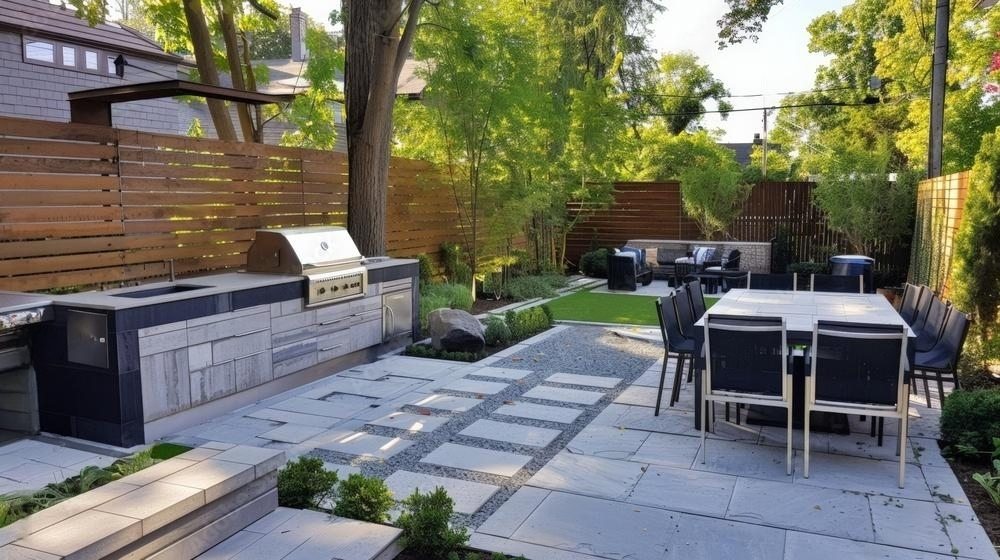
Hardscape refers to the non-living, solid elements incorporated into landscape design. This includes materials like concrete, brick, stone, and wood used for patios, walkways, retaining walls, driveways, and outdoor kitchens. Unlike softscape (plants, grass, and soil), hardscape provides structure and functionality to your yard. For homeowners in San Jose, CA, a well-planned hardscape can increase property value and reduce water usage. If you are considering a specific project, such as a paver patio, you can review our internal article titled Estimating A 20x20 Paver Patio Cost In Mountain View for detailed cost insights. D&D Home Remodeling recommends consulting a professional to ensure proper drainage and material selection for your local climate.
Landscaping and hardscaping are two distinct components of outdoor design. Landscaping refers to the living elements of a yard, such as plants, trees, grass, flowers, and soil. It focuses on horticulture and the natural, organic features that grow and change with the seasons. Hardscaping, on the other hand, involves the non-living, man-made structures like patios, walkways, retaining walls, driveways, and stone pathways. These elements provide structure and functionality to the outdoor space. A well-designed property often integrates both for balance. For homeowners in San Jose, CA, blending these elements with water-wise plants can create a sustainable and beautiful yard. For more ideas, you can refer to our internal article titled Exterior Home Remodel: Drought-Tolerant Landscaping Integration.
Hardscaping costs are driven by several key factors that reflect the quality and durability of the work. The primary expense is labor, as installing patios, retaining walls, or walkways requires heavy machinery, precise excavation, and skilled craftsmanship to ensure proper drainage and a level base. Material costs also add up quickly; natural stone, pavers, and concrete are heavy and expensive to transport. Additionally, a proper hardscape involves multiple layers of gravel, sand, and compacted base material to prevent shifting over time. For homeowners in San Jose, CA, the local climate and soil conditions often demand extra preparation. If you are considering a more cost-effective outdoor upgrade, you might find value in our internal article titled So Your Lawn Looks Like a Crispy Taco? Let's Build a Drought-Tolerant Paradise Instead, which explores alternatives to traditional hardscaping.
An example of a hardscape is a paver patio, which is a non-living, structural element added to a landscape. Hardscapes include materials like concrete, stone, brick, or wood used for features such as walkways, retaining walls, driveways, and outdoor kitchens. These elements provide functionality and define outdoor spaces. For a detailed breakdown on pricing and planning, you can refer to our internal article titled Estimating A 20x20 Paver Patio Cost In Mountain View. At D&D Home Remodeling, we emphasize that proper base preparation and drainage are critical for any hardscape to ensure long-term durability and prevent shifting or water damage.